In this article
- The Sixteen Picks at a Glance
- Engine Builders: Cheap Early Turns, Expensive Late Ones
- Economic Euros That Squeeze You Dry
- Area Control Games Where Every Border Is a Threat
- Head-to-Head: Games Built for Exactly Two Players
- Co-op Games That Turn the Board Into Your Opponent
- Twilight Imperium and Diplomacy Take the Whole Day
- Catan, Ticket to Ride, Monopoly and Risk: Where the Classics Land
- Quick Answers: Best, Hardest and What Counts as Strategy
- Pick Your Pressure
Sixteen picks grouped by how they squeeze you.
Most lists treat “strategy” as one flavor. It isn’t. Brass: Birmingham squeezes you slowly until you’re arguing with yourself over a single barrel of beer. Root makes you stare at the cat player, who hasn’t attacked in two turns, and wonder what she’s building toward.
Spirit Island hands you a clock and dares you to beat it. Same shelf label, completely different ways of making your palms damp.
So instead of ranking these one to sixteen, I sorted them by where the tension comes from, because that’s what decides whether a game becomes a regular at your table or gets played once and shelved.
My bar for what counts here is simple. Your decisions should decide the game more than the dice do, and a good player should beat a new one most of the time. That bar rules out Monopoly and most of Risk (more on those near the end). Everything below clears it, from a 40-minute bird game to a space opera that eats an entire Saturday.
The Sixteen Picks at a Glance
If you already know what kind of game you want, this table gets you there fastest. Everything in it sits in our wider strategy games category too.
| Game | Type | Players | Play time |
|---|---|---|---|
| Wingspan | Engine builder | 1-5 | 40-70 min |
| Ark Nova | Engine builder | 1-4 | 90-150 min |
| Terraforming Mars | Engine builder | 1-5 | About 2 hours |
| Brass: Birmingham | Economic | 2-4 | 60-120 min |
| Concordia | Economic | 2-5 | 90-120 min |
| Power Grid | Economic, auction | 2-6 | About 2 hours |
| Root | Asymmetric area control | 2-4 | 60-90 min |
| Dune: Imperium Uprising | Deck building, worker placement | 1-4 (6 in teams) | 60-120 min |
| Scythe | Engine builder, area control | 1-5 | 90-115 min |
| 7 Wonders Duel | Two-player | 2 | 30 min |
| Twilight Struggle | Two-player | 2 | 2-3 hours |
| War of the Ring | Two-player | 2-4 | 3 hours or more |
| Spirit Island | Co-op | 1-4 | 90-120 min |
| Pandemic Legacy: Season 1 | Co-op campaign | 2-4 | About 1 hour per session |
| Twilight Imperium 4th Edition | Epic | 3-6 | 4-8 hours |
| Diplomacy | Negotiation | 7 (variants for fewer) | 4 hours or more |
Engine Builders: Cheap Early Turns, Expensive Late Ones
An engine builder starts you with almost nothing and asks you to invest in things that pay out later. The tension creeps in. For the first half hour everything feels generous, and then you look at the round tracker and realize you have four turns left and an engine that needs six to pay off.
Wingspan
Wingspan has a reputation as the relaxing bird game, and it earns maybe half of it. The art is lovely and nobody attacks anybody.
But you get eight actions in the first round, seven in the second, six in the third and five in the last, while every new bird costs more eggs to play. The engine gets pricier to run exactly as your turns disappear. That squeeze is the whole game.
Is it deep enough to earn a spot here? It’s the lightest game in this section, and I won’t pretend otherwise. What it does better than anything else here is teach new players what “engine” means without scaring them off. I get into the shrinking-clock problem and which expansions to add in my full writeup on Wingspan.
For couples, Wingspan Asia works as a standalone two-player box. If you’ve outgrown the base game, Wyrmspan swaps birds for dragons and adds cave excavation, a layer of planning that makes the whole thing noticeably crunchier.
One gap in the series still bugs me, and I wrote about why Wingspan still has no Africa expansion if you want the full grumble.
Ark Nova
Ark Nova is where you go when Wingspan starts feeling solved. You’re building a modern zoo: enclosures, animals, sponsors, conservation projects, 255 unique cards. On paper that’s too much. The action system keeps it sane.
You have five action cards in a row, each with a strength from one to five based on its slot. Play a card and it drops back to slot one, pushing everything else up. So the move you want right now is often the weak version of that move, and waiting a turn makes it stronger. Every turn becomes a small bet on patience.
Scoring runs on two tracks heading toward each other, appeal and conservation, and the game ends when yours cross. Expect two-plus hours at four players. I think it’s at its best with two, where turns come back around fast enough that you never lose the thread.
Terraforming Mars
Every player in Terraforming Mars is pushing three shared numbers (temperature, oxygen and ocean tiles), and the game ends once all three hit their maximums. That’s the part people underrate. Every time you raise the temperature, you’re scoring points and also shortening the game for everyone, including the person whose engine is still warming up.
There are 208 project cards, so no two games run alike. Play with the drafting variant from the rulebook. Without it, card luck swings too hard for a two-hour game. The components are functional at best and the first play will run long while everyone reads cards out loud. Neither of those stops it from being one of the most replayed boxes in my collection.
Economic Euros That Squeeze You Dry
Economic games don’t have big dramatic swings. They tighten a little each round, like a belt you keep having to notch. By the end you’re counting coins twice and still getting it wrong.
Brass: Birmingham
If I had to keep one game from this entire list, it would be Brass. You’re an industrialist in the English Midlands across two eras, canals then rail, building coal mines, ironworks, breweries and factories, and connecting them to markets.
The clever part is that you rarely produce everything yourself. Need coal for a factory? You can burn your rival’s coal, which flips their mine and scores them points. Every shortcut you take feeds someone else. Selling goods needs beer, beer comes from breweries, and half the time the nearest brewery belongs to the player you least want to help.
Turn order matters too. Whoever spent the least money in a round goes first in the next one, so being cheap buys you tempo. Toward the end of the rail era you’ll often have no idea who’s winning, and that uncertainty is what makes the last few turns so tense.
The downside is a real one. Players prone to overthinking will stall, and a first game runs close to three hours. The rulebook includes a shortened introductory version, but it strips out most of what makes Brass special.
Concordia
Concordia is the calm one in this section, and I mean that as praise. Everyone starts with the same hand of personality cards. You play one per turn and do what it says: move colonists, build houses, produce goods, buy new cards. When you want your cards back, you play the Tribune.
Scoring happens entirely at the end, through gods printed on the cards you collected, so you can win a game you thought you were losing. People call it luck-free. It isn’t quite. The card market refills from a shuffled deck and the city goods are randomized at setup. Still, luck matters less here than in almost any game on this list, and it plays well at two players.
Power Grid
Power Grid is an auction game wearing a spreadsheet. You bid on power plants, buy coal, oil, garbage and uranium from a shared market, and pay to connect cities. Money is tight enough that a single overbid can haunt you for three rounds.
The rule that makes it work is often explained backwards. Turn order is based on how many cities you’ve connected. The leader goes first in the auction, where going first is a disadvantage. Then the order reverses: the player in last place buys fuel first at the cheapest prices and builds first into the cheapest cities. The leader pays top price for everything. It’s an elegant brake on runaway wins, and it keeps the final round close more often than you’d expect.
Get the Recharged edition if you’re buying new, and budget time for arithmetic.
Area Control Games Where Every Border Is a Threat
Area control games put everyone on one crowded map. The tension is spatial. You can see the attack coming, you just can’t always stop it.
Root
Root looks like a children’s book and plays like a knife fight. Four factions share a woodland map, and each one runs on different rules. The Marquise de Cat builds an industrial empire. The Eyrie Dynasties follow a decree that grows every turn and collapses into turmoil the moment they can’t fulfill it. The Woodland Alliance spreads sympathy and sparks revolts. The Vagabond wanders around making deals and ruining everyone’s plans.
Teaching Root is like teaching four games at once. The first play is a rehearsal, full stop. Plan for it, then play again the same night if people are willing, because the second game is where it clicks. Someone wins at 30 points or by completing a dominance card, and the table has to police the leader, since nobody else will.
A word of warning on the Eyrie. Falling into turmoil twice in a row can wreck a new player’s game, so give that faction to someone who enjoys a puzzle that punishes mistakes.
Like the idea of every player chasing a different goal, but Root sounds like too much? Disney Villainous gives each player a villain with a unique win condition at a far lighter weight, and it handles two to six players.
Dune: Imperium Uprising
Dune: Imperium blends deck building with worker placement. Your cards decide which spaces on the board you can visit, and those spaces improve your deck. Uprising is the version I’d buy. It adds spies, contracts and sandworms that double your rewards in a conflict. More importantly, it pushes you into combat nearly every round, where the original let players sit out and build quietly.
Hidden intrigue cards mean you’re never fully sure you’ve won until the last one is played. It also has a six-player team mode, rare for a game this sharp.
Scythe
No game on this list starts more arguments than Scythe. It’s set in an alternate 1920s Eastern Europe full of giant mechs, it looks spectacular, and depending on who you ask it’s either a tense war game or a solitaire puzzle with plastic robots.
I’ve heard four versions of the case. One camp says it’s a race to execute a memorized opening, and experienced players know their full sequence of moves before turn one. Another insists it’s best at two players, because an opponent with nobody else to worry about will come at you and break that script.
A third points to the star system (the game ends the instant someone places a sixth star) as the thing that makes the final turns tense, since you’re always calculating whether you can grab one more before someone else ends it. The fourth calls it multiplayer solitaire with occasional fights.
They’re all a little right. My take: Scythe is a race dressed up as a war. Combat rarely happens, but the threat of it shapes every move. If you like efficiency puzzles with menace in the background, you’ll love it. If you want armies clashing every round, get Root instead.
Scythe and Wingspan share a publisher, and both land in my ranking of the best Stonemaier games, where I explain which of the two has aged better.
Head-to-Head: Games Built for Exactly Two Players
With just two players there’s nobody else to blame and nobody to gang up on the leader. It’s you, your opponent and every mistake laid bare.
7 Wonders Duel
Treat this as its own game rather than a shrunk-down 7 Wonders, and a better one at this count. Cards are laid out in a pyramid, some face down, and taking a card can reveal a new one for your opponent. You’re always thinking one move ahead of what you want to take.
There are three ways to win: push the military track into your opponent’s capital, collect six different science symbols, or have the most points when all three ages are done. Only one of those has to go right for you, and your opponent has to watch all three. Thirty minutes, and it fits in a coat pocket.
Twilight Struggle
The Cold War in about three hours. One player is the USA, the other the USSR, fighting for influence across the globe with a deck of historical event cards. The cruel twist is that many cards belong to your opponent’s side, and when you play one for its points, their event fires anyway. Every hand is damage control.
Push the DEFCON track to one on your own turn and you’ve started a nuclear war and lost. So you can’t be aggressive everywhere, all the time. It’s heavy, long and best with a regular opponent. If you have one, few games reward repeat play this much.
War of the Ring
The Lord of the Rings as a full war game: one side controls the Free Peoples, the other the Shadow armies of Sauron. The Free Peoples can win militarily, but their real hope is sneaking the Fellowship to Mount Doom while the Shadow player hunts it. The Shadow can win by conquering enough strongholds or by corrupting Frodo.
Two different wars on one board, running at once. It’s the most requested two-player game among people I know who play heavy games, and it deserves the praise. Two cautions. It runs three hours or more, and many experienced players find the base game favors the Shadow. The first two expansions are the usual fix.
Multiplayer Games That Shine With Two
Plenty of games on this list are at their best with two, even though the box says four. Brass, Ark Nova and Concordia all get tighter and faster with just two players. Before buying anything for two, check the player-count poll on BoardGameGeek. If more than roughly a third of votes say “not recommended” at two players, believe them.
Co-op Games That Turn the Board Into Your Opponent
Co-ops replace the rival across the table with a system trying to kill you. The tension comes from watching a clock you can’t stop.
Spirit Island
You’re spirits of an island, defending it from colonizing invaders. The invaders are predictable: they explore, build and ravage on a visible schedule. You can see exactly where the damage is coming next turn. The puzzle is that you can’t stop all of it, and every power card is either fast (it resolves before the invaders act) or slow (after), which decides whether you’re preventing damage or cleaning it up.
It’s the best co-op strategy game I know, with one real flaw. Games sometimes end with a whimper. One player clears the last towns with a fast power, the win triggers, and the final turn everyone planned for never happens. That doesn’t happen often, but it’s frustrating when it does.
If you want co-op for two in under 20 minutes, Sky Team has you landing a plane with a partner using dice and almost no talking. It’s far lighter than anything else in this section and one of the best-rated games on this site.
Pandemic Legacy: Season 1
Base Pandemic is a fine game with a known problem: one experienced player can end up making everyone’s decisions for them. The Legacy version is still vulnerable to that, but the campaign gives the table so much to argue about that nobody stays quiet for long.
You play through a year of months, 12 to 24 sessions depending on how often you fail, and the game changes permanently each time. Cities fall, rules are added, stickers go on the board forever. It’s one playthrough and done, and the story it builds is worth every cent of that trade.
Twilight Imperium and Diplomacy Take the Whole Day
Some games aren’t an evening, they’re an event. The tension here comes from investment: after six hours of building an empire, every vote and every betrayal feels enormous.
Twilight Imperium 4th Edition
Three to six players, a galaxy built from hex tiles, and a realistic playtime of six to eight hours for a first game. Each round you pick a strategy card that shapes your role, then expand, trade, fight and vote on galactic laws. First to ten victory points wins.
The rules aren’t the hard part. The table is. Treaties get broken, trades get renegotiated in the hallway, and the whole group will still be arguing about round four’s vote days later. Only buy it if you have a group that will commit a full day, more than once.
Diplomacy
No dice, no cards, no luck at all. Seven players negotiate, then write secret orders for their armies at the same moment. Everything rides on trust, and the moment of the game is the backstab you didn’t see coming. It will damage friendships, and that’s the point.
Catan, Ticket to Ride, Monopoly and Risk: Where the Classics Land
These four show up on every list, so here’s where each one falls against the bar I set at the top.
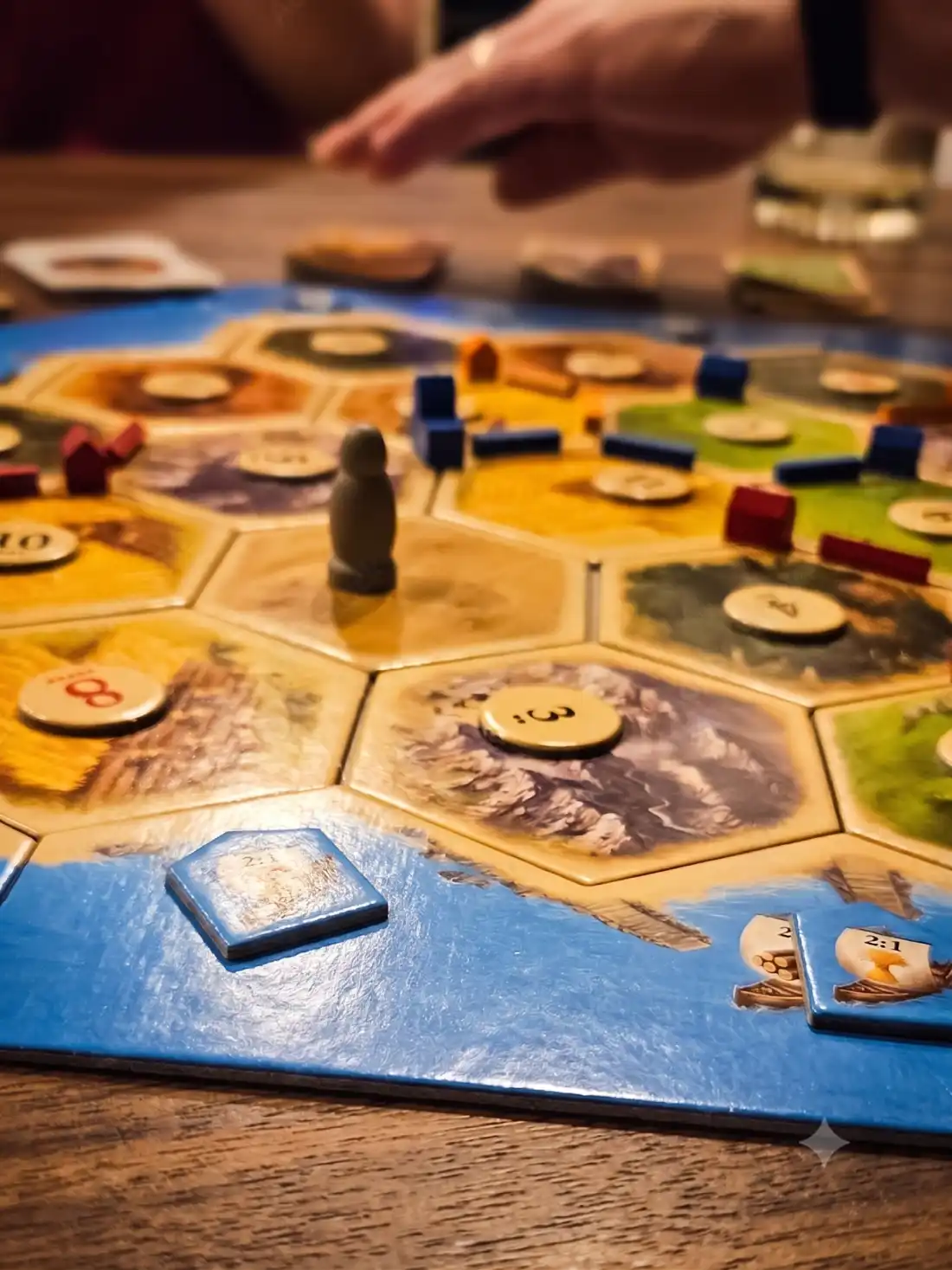
Catan is a strategy game with a dice problem. Opening placement and trading take real skill, and the robber punishes whoever’s leading. But a bad run of rolls can sink a good player. It’s still a great first step. I go through what separates good Catan players from lucky ones in my Catan strategy guide.
Ticket to Ride is lighter than anything in the main list and a brilliant gateway game. The destination tickets add real risk, since an unfinished route costs you its points. It gets thin at two players, when the board opens up and nobody gets blocked.
Monopoly fails the bar. Once the properties are bought, the game plays itself. Most families also skip the official rule that unbought property goes to auction, and add a Free Parking jackpot that isn’t in the rules. Together, those two changes are why Monopoly lasts forever.
Risk has more decisions than Monopoly, but dice decide every battle and turtling is usually the best play. If your group loves Risk, Small World or Root will feel like the game Risk was reaching for.
If you’re bringing new players up from these, start with my guide to strategy board games for beginners, which picks games that each teach one real skill.
Quick Answers: Best, Hardest and What Counts as Strategy
What is the best strategy board game right now?
For competitive play, Brass: Birmingham. It combines economic depth, player interaction and a tense finish better than anything else I’ve played. For co-op, Spirit Island. For two players, 7 Wonders Duel if you have half an hour, Twilight Struggle if you have an evening.
What is the hardest strategy board game ever made?
The Campaign for North Africa, a 1979 wargame with an estimated playtime of around 1,500 hours. It’s famous for a rule that makes Italian troops use extra water to cook pasta.
Among games people still play regularly, Twilight Imperium 4 and Twilight Struggle are about as demanding as it gets.
What makes a board game a strategy game?
Your choices, not luck, decide the result, and a skilled player beats a new one most of the time. Almost every game has some strategy in it, but this label is for the ones where it outweighs everything else.
Are strategy board games good for two players?
Many are better at two. Dedicated duels like 7 Wonders Duel, Twilight Struggle and War of the Ring are built for it, and bigger games like Brass, Ark Nova and Concordia tighten up nicely with two.
Pick Your Pressure
Don’t choose by rating. Choose by the kind of sweat you want. A slow build you can plan around? Engine builders. A tightening budget? Brass or Power Grid. A rival you can see coming? Root. A clock ticking down? Spirit Island. Match the pressure to your group and the game will earn its spot at your table.